
Essential Skills Required for Data Scientists: Technical & Soft Skills
- woodcroft university
- Jul 23
- 5 min read

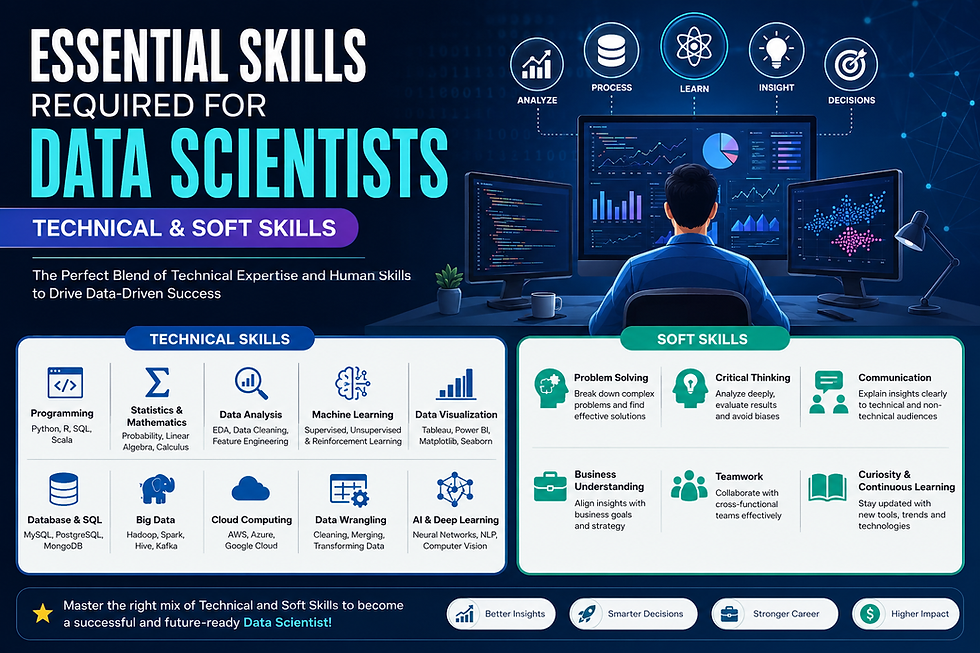
The demand for data scientists continues to grow across industries, making it one of the most sought-after careers in technology. Organizations rely on data professionals to uncover valuable insights, predict trends, and support data-driven decision-making. However, becoming a successful data scientist requires much more than learning programming languages.
To build a successful career, professionals need a balanced combination of technical expertise, analytical thinking, business understanding, and communication skills. In this guide, we'll explore the Skills Required for Data Scientist, covering both technical and soft skills that employers expect in 2026 and beyond.
Why Skills Matter in Data Science
Data science is a multidisciplinary field that combines mathematics, statistics, programming, artificial intelligence, and business strategy. Companies don't simply hire someone who can write Python code—they need professionals who can solve real business problems using data.
Developing the right skills helps you:
Analyze complex datasets
Build predictive models
Automate business processes
Improve decision-making
Increase career opportunities
Earn higher salaries
Adapt to new technologies
A strong skill set also makes it easier to transition into specialized roles like Machine Learning Engineer, AI Engineer, or Data Analytics Manager.
Technical Skills Required for Data Scientists
Technical expertise forms the foundation of every successful data science career.
Programming Skills
Programming is one of the most important Skills Required for Data Scientists. It allows professionals to collect, clean, analyze, and visualize data efficiently.
The most popular programming languages include:
Python
R
SQL
Scala
Java
Among these, Python remains the industry standard because of its simplicity and extensive libraries.
Useful Python libraries include:
Pandas
NumPy
Scikit-learn
TensorFlow
PyTorch
Matplotlib
Seaborn
Learning programming enables automation and simplifies complex analytical tasks.
Statistics and Mathematics
Without statistics, data science cannot exist.
A data scientist should understand:
Probability
Linear Algebra
Calculus
Hypothesis Testing
Bayesian Statistics
Descriptive Statistics
Inferential Statistics
These concepts help professionals interpret data correctly and build accurate predictive models.
Strong mathematical knowledge also improves machine learning performance and algorithm selection.
Data Analysis Skills
Analyzing raw data is one of the core responsibilities of every data scientist.
Professionals should know how to:
Clean datasets
Handle missing values
Detect outliers
Identify trends
Explore relationships
Prepare datasets for modeling
Exploratory Data Analysis (EDA) helps uncover hidden insights before machine learning models are developed.
SQL and Database Management
Almost every organization stores information inside databases.
Therefore, SQL remains one of the essential Skills Required for Data Scientists.
Important SQL concepts include:
SELECT statements
JOIN operations
GROUP BY
Aggregations
Window functions
Stored procedures
Indexing
Knowledge of databases like MySQL, PostgreSQL, MongoDB, and SQL Server is highly valuable.
Machine Learning
Machine learning is among the most in-demand skills for data scientists.
Professionals should understand:
Supervised Learning
Examples include:
Linear Regression
Logistic Regression
Decision Trees
Random Forest
Support Vector Machines
Unsupervised Learning
Examples include:
K-Means Clustering
Hierarchical Clustering
Principal Component Analysis (PCA)
Reinforcement Learning
Useful for robotics, gaming, and autonomous systems.
Understanding when to use each algorithm is just as important as implementing them.
Data Visualization
Data becomes valuable only when people understand it.
Visualization tools help present findings clearly.
Popular visualization tools include:
Tableau
Power BI
Matplotlib
Seaborn
Plotly
Excel
An effective dashboard communicates insights quickly to both technical and non-technical audiences.
Big Data Technologies
Modern businesses generate enormous volumes of data.
Data scientists should understand technologies like:
Hadoop
Apache Spark
Hive
Kafka
Databricks
These platforms help process millions—or even billions—of records efficiently.
Cloud Computing
Cloud platforms have become essential for storing and processing data.
Popular cloud services include:
Amazon Web Services (AWS)
Microsoft Azure
Google Cloud Platform (GCP)
Understanding cloud computing allows data scientists to build scalable AI solutions.
Data Wrangling
Raw data is often incomplete and messy.
Data wrangling involves:
Removing duplicates
Correcting errors
Handling null values
Formatting data
Combining datasets
Experienced data scientists often spend more than half of their project time cleaning data.
Artificial Intelligence
Modern data science increasingly overlaps with AI.
Useful AI concepts include:
Neural Networks
Deep Learning
Natural Language Processing (NLP)
Computer Vision
Large Language Models (LLMs)
AI knowledge significantly expands career opportunities.
Soft Skills Required for Data Scientists
Technical expertise alone isn't enough. Employers also value interpersonal and business skills.
Problem-Solving Skills
Data scientists solve real-world business challenges.
They should be able to:
Break down complex problems
Choose appropriate methods
Test multiple solutions
Evaluate outcomes
Creative problem-solving often distinguishes exceptional professionals.
Critical Thinking
Critical thinking enables professionals to question assumptions and validate results.
Strong critical thinkers:
Verify data quality
Avoid misleading conclusions
Identify biases
Evaluate multiple possibilities
This leads to more reliable business decisions.
Communication Skills
One of the most overlooked Skills Required for Data Scientists is communication.
Professionals must explain technical findings in simple language.
Communication includes:
Writing reports
Presenting dashboards
Explaining machine learning models
Collaborating with executives
Good communication bridges the gap between data and decision-makers.
Business Understanding
A successful data scientist understands business objectives—not just algorithms.
Business knowledge helps professionals:
Identify valuable insights
Improve profitability
Reduce operational costs
Support strategic planning
Technical skills become far more impactful when aligned with business goals.
Teamwork
Data science projects involve collaboration with:
Software Engineers
Business Analysts
Product Managers
Data Engineers
Executives
Strong teamwork improves project success and organizational efficiency.
Curiosity and Continuous Learning
Technology changes rapidly.
Successful data scientists stay updated with:
New AI models
Programming libraries
Research papers
Cloud services
Industry trends
Continuous learning keeps professionals competitive.
Time Management
Data science projects often involve multiple deadlines.
Good time management helps professionals:
Prioritize tasks
Manage workloads
Deliver projects on time
Maintain productivity
Planning and organization are valuable career skills.
Adaptability
Every project presents different datasets, tools, and business challenges.
Adaptable professionals can:
Learn new software
Switch programming languages
Handle changing requirements
Work across industries
Adaptability is becoming increasingly important in AI-driven workplaces.
Essential Tools Every Data Scientist Should Learn
Beyond skills, familiarity with industry-standard tools strengthens your profile.
Common tools include:
Python
R
SQL
Jupyter Notebook
VS Code
Tableau
Power BI
Excel
Apache Spark
TensorFlow
PyTorch
Git & GitHub
Docker
AWS
Azure
Google Cloud
Hands-on experience with these tools demonstrates practical capability.
How to Develop Data Science Skills
Building the Skills Required for Data Scientists takes consistent practice.
A practical roadmap includes:
Learn Python and SQL.
Study statistics and probability.
Practice data cleaning and visualization.
Build machine learning projects.
Participate in Kaggle competitions.
Create a GitHub portfolio.
Learn cloud computing basics.
Explore deep learning and generative AI.
Read research papers and blogs.
Work on real-world datasets.
Consistency matters more than speed.
Common Mistakes Beginners Make
Many aspiring data scientists slow their progress by making avoidable mistakes.
Common pitfalls include:
Ignoring statistics
Memorizing algorithms without understanding
Skipping SQL
Building projects without business context
Avoiding communication practice
Not creating a portfolio
Learning too many tools at once
Neglecting data cleaning
Focusing on fundamentals first creates a stronger foundation.
Career Opportunities After Learning Data Science Skills
Once you've mastered the necessary skills, numerous career paths become available.
Popular job roles include:
Data Scientist
Machine Learning Engineer
Data Analyst
AI Engineer
Business Intelligence Analyst
Research Scientist
Data Engineer
Quantitative Analyst
NLP Engineer
Computer Vision Engineer
These roles are available across healthcare, finance, e-commerce, manufacturing, education, and technology sectors.
Future Skills Data Scientists Should Learn
The future of data science continues to evolve.
Emerging skills include:
Generative AI
Large Language Models (LLMs)
AI Agents
Prompt Engineering
MLOps
Explainable AI (XAI)
Edge AI
Responsible AI
Vector Databases
Retrieval-Augmented Generation (RAG)
Learning these technologies will help professionals stay competitive in the coming years.
Conclusion:
Mastering the Skills Required for Data Scientist involves much more than learning to code. Success comes from combining technical expertise with strong analytical thinking, communication, problem-solving, and business understanding. As AI and machine learning continue to reshape industries, professionals who continuously learn and adapt will have the greatest opportunities. Whether you're a beginner or an experienced professional, investing in these essential skills will prepare you for a rewarding and future-proof career in data science.


Comments