
How to Become a Data Scientist: Skills, Projects, and Portfolio Tips
- woodcroft university
- May 28
- 9 min read

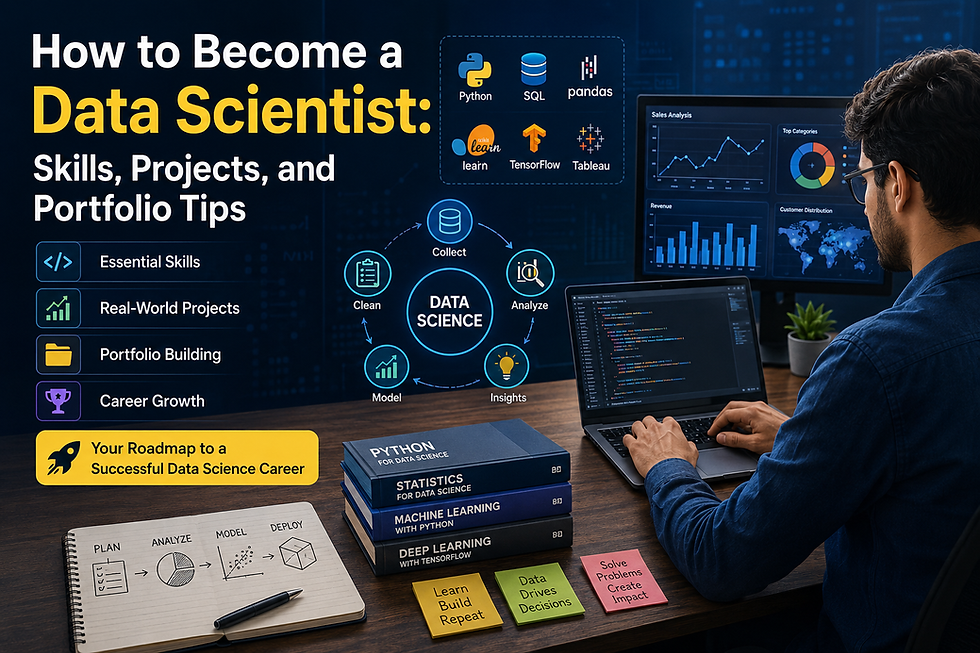
Introduction to Data Science
Data science is one of the fastest-growing career fields in the digital world. Businesses use data science to analyze information, predict trends, and make smarter decisions. From healthcare and finance to eCommerce and social media, data science is everywhere.
If you enjoy solving problems, working with numbers, and learning technology, becoming a data scientist can be a rewarding career choice. This guide explains the skills, tools, and learning path required to become a successful data scientist in 2026.
Who Is a Data Scientist?
A data scientist is a professional who collects, analyzes, and interprets large amounts of data. They use programming, statistics, and machine learning to discover useful insights.
Data scientists help companies improve products, understand customer behavior, and increase business growth. They often work with datasets, create predictive models, and present findings through visual reports.
The role combines technical skills, analytical thinking, and business understanding.
Why Data Science Is a High-Demand Career
Data science has become one of the most in-demand careers because companies rely heavily on data-driven decisions. Organizations generate huge amounts of data daily and need experts to manage and analyze it.
The demand for skilled data scientists continues to grow in industries such as banking, healthcare, education, cybersecurity, and marketing. High salaries, remote work opportunities, and career growth make data science an attractive profession for beginners and experienced professionals alike.
Essential Skills Required to Become a Data Scientist
To become a successful data scientist, you need both technical and soft skills. Technical skills include programming, machine learning, data visualization, and statistics. Soft skills include communication, problem-solving, and critical thinking.
A data scientist must understand how to work with data, identify patterns, and explain insights clearly. Learning these skills step by step helps beginners build a strong foundation and improve their career opportunities in the data science industry.
Technical Skills Every Data Scientist Must Learn
Technical skills are extremely important in data science. You should learn programming languages like Python and SQL, along with tools for data analysis and visualization. Machine learning, deep learning, and cloud computing are also valuable skills.
Understanding algorithms, data structures, and database management can improve your efficiency. Familiarity with tools such as Jupyter Notebook, TensorFlow, and Power BI also helps you work on real-world projects more effectively.
Importance of Mathematics and Statistics in Data Science
Mathematics and statistics are the backbone of data science. Concepts like probability, linear algebra, and calculus help data scientists understand machine learning algorithms and predictive models.
Statistics is used to analyze data, identify trends, and make accurate predictions. Without a strong understanding of these subjects, it becomes difficult to interpret data correctly. Beginners should focus on learning basic statistical concepts before moving into advanced machine learning topics.
Best Programming Languages for Data Science
Several programming languages are used in data science, but Python is the most popular because of its simplicity and powerful libraries. R is also widely used for statistical computing and data visualization.
SQL is essential for handling databases and extracting data efficiently. Some professionals also use Java, Julia, and Scala for big data and advanced analytics. Choosing the right language depends on your career goals and project requirements.
Learning Python for Data Science
Python is considered the best programming language for beginners in data science. It has simple syntax and offers powerful libraries like NumPy, Pandas, Matplotlib, and Scikit-learn.
Python is used for data analysis, machine learning, automation, and visualization. Beginners should start by learning Python basics such as variables, loops, functions, and data structures before moving into advanced data science concepts. Practicing coding regularly is the best way to improve your Python skills.
Understanding Data Analysis and Data Visualization
Data analysis involves examining datasets to discover patterns, trends, and useful insights. Data visualization helps present information through charts, graphs, and dashboards.
Visualization tools like Tableau, Power BI, and Matplotlib make complex data easier to understand. Good visualization improves decision-making and communication within organizations. Learning how to clean, analyze, and visualize data is essential for every aspiring data scientist.
Machine Learning Basics for Beginners
Machine learning is a major part of data science. It allows computers to learn patterns from data and make predictions without explicit programming.
Beginners should understand supervised learning, unsupervised learning, and reinforcement learning. Popular machine learning algorithms include linear regression, decision trees, and clustering methods. Python libraries such as Scikit-learn simplify machine learning development. Building small projects can help beginners understand these concepts more effectively.
Deep Learning and Artificial Intelligence Fundamentals
Deep learning is an advanced branch of machine learning that uses neural networks to solve complex problems. It is widely used in image recognition, speech processing, and natural language processing.
Artificial intelligence focuses on creating systems that can perform tasks requiring human intelligence. Technologies like chatbots, recommendation systems, and self-driving cars rely on AI and deep learning. Learning these concepts can open opportunities in advanced data science careers.
How to Learn SQL for Data Science
SQL, or Structured Query Language, is used to manage and retrieve data from databases. Data scientists use SQL to filter, organize, and analyze large datasets efficiently.
Beginners should learn SQL commands like SELECT, WHERE, JOIN, GROUP BY, and ORDER BY. Practicing database queries regularly helps improve problem-solving skills. Strong SQL knowledge is highly valuable because most companies store their data in relational databases.
Working with Big Data Technologies
Big data technologies help manage extremely large datasets that traditional tools cannot handle efficiently. Popular big data tools include Hadoop, Spark, and Apache Kafka.
These technologies are used by companies handling millions of records daily. Learning big data tools helps data scientists process information faster and work with real-time analytics. Although beginners can start with basic data science skills first, understanding big data becomes important as your career grows.
Data Cleaning and Data Preprocessing Skills
Data cleaning is one of the most important tasks in data science. Raw data often contains errors, duplicates, and missing values that can affect analysis results.
Data preprocessing involves transforming and organizing data into a usable format. Techniques like normalization, feature scaling, and handling missing values improve model performance. Learning how to clean data properly helps create accurate machine learning models and reliable business insights.
Tools and Software Used by Data Scientists
Data scientists use various tools and software for data analysis, visualization, and machine learning. Popular tools include Jupyter Notebook, Google Colab, Tableau, Power BI, TensorFlow, and Apache Spark.
Version control platforms like Git and GitHub are also important for collaboration and portfolio building. Cloud platforms such as AWS and Google Cloud are increasingly used in modern data science projects. Mastering these tools can improve productivity and career opportunities.
How to Build Real-World Data Science Projects
Building real-world projects is one of the best ways to improve your data science skills. Projects help you apply theoretical knowledge to practical problems and demonstrate your abilities to employers.
Start with simple projects like sales prediction, movie recommendation systems, or customer segmentation. Use real datasets from platforms like Kaggle and UCI Machine Learning Repository. Focus on solving real business problems and documenting your project process clearly.
Beginner-Friendly Data Science Project Ideas
Beginners should start with simple and manageable projects to gain confidence. Projects such as Titanic survival prediction, spam email detection, weather forecasting, and student performance analysis are excellent starting points.
These projects teach data cleaning, visualization, and machine learning basics. Working on beginner-friendly projects also helps you understand how different algorithms work. Regular project practice improves problem-solving skills and prepares you for advanced data science tasks.
Intermediate and Advanced Data Science Projects
After mastering the basics, you can move to intermediate and advanced projects. Examples include fraud detection systems, stock price prediction, recommendation engines, sentiment analysis, and image classification models.
Advanced projects often involve deep learning, big data processing, and cloud technologies. These projects strengthen your portfolio and showcase your ability to solve complex business challenges. Employers value candidates who can build complete end-to-end data science solutions.
Importance of Kaggle and Online Competitions
Kaggle is one of the most popular platforms for data science learning and competitions. It provides datasets, notebooks, tutorials, and real-world machine learning challenges.
Participating in competitions helps improve your analytical thinking and practical coding skills. You can also learn from experienced professionals by studying public notebooks and solutions. A strong Kaggle profile can enhance your resume and increase your visibility in the data science community.
How to Create a Strong Data Science Portfolio
A strong portfolio helps showcase your technical skills and practical experience. Your portfolio should include well-documented projects, datasets, visualizations, and machine learning models.
Each project should explain the problem, data analysis process, tools used, and final results. Employers often evaluate portfolios before interviews, so quality matters more than quantity. A professional portfolio can significantly improve your chances of getting hired as a data scientist.
Best Portfolio Platforms for Data Scientists
There are several platforms where data scientists can showcase their work. GitHub is the most popular platform for sharing code and project documentation. Kaggle is also excellent for displaying machine learning projects and competition rankings.
You can create a personal portfolio website using platforms like WordPress, Wix, or GitHub Pages. LinkedIn is another useful platform for highlighting projects, certifications, and career achievements to recruiters.
How to Write Project Descriptions That Impress Recruiters
A well-written project description can make your portfolio stand out. Start by clearly explaining the problem statement and business objective. Mention the dataset, tools, programming languages, and machine learning models used in the project.
Highlight key findings, model accuracy, and business impact. Keep descriptions concise but informative. Recruiters prefer candidates who can explain technical work in simple language that demonstrates both technical and communication skills.
Building a GitHub Profile for Data Science
GitHub is an essential platform for data science professionals. It allows you to store code, manage projects, and collaborate with other developers.
A professional GitHub profile should contain organized repositories, proper documentation, README files, and clean code. Regularly uploading projects shows consistency and dedication. Employers often review GitHub profiles to evaluate coding skills and project experience before hiring candidates.
Certifications That Can Help You Become a Data Scientist
Certifications can improve your credibility and demonstrate your knowledge to employers. Popular data science certifications are offered by Google, IBM, Microsoft, Coursera, Udemy, and DataCamp.
These certifications cover topics such as Python, machine learning, SQL, deep learning, and cloud computing. Although certifications alone cannot guarantee a job, they can strengthen your resume and help beginners gain structured learning experience.
Best Online Courses and Learning Resources
Many online platforms provide high-quality data science courses for beginners and professionals. Popular learning platforms include Coursera, Udemy, edX, DataCamp, and freeCodeCamp.
YouTube tutorials, blogs, and official documentation are also valuable learning resources. Beginners should focus on hands-on learning through coding exercises and projects. Consistent practice combined with quality learning materials can accelerate your journey toward becoming a successful data scientist.
Common Mistakes Beginners Should Avoid
Many beginners make the mistake of learning too many tools without mastering the basics. Focusing only on theory without building projects is another common issue.
Some learners also ignore statistics, SQL, and data cleaning, which are essential skills in data science. Avoid comparing your progress with others and focus on consistent learning. Building practical experience step by step is more important than rushing through multiple technologies.
How Long Does It Take to Become a Data Scientist?
The time required to become a data scientist depends on your background, learning speed, and dedication. Beginners usually need six months to two years to build strong data science skills.
Learning programming, statistics, machine learning, and project development takes consistent effort. Working on projects regularly and practicing coding daily can speed up the process. Continuous learning is important because data science technologies evolve rapidly.
Data Scientist Salary and Career Opportunities
Data science offers excellent salary packages and career growth opportunities. Salaries vary depending on experience, location, and skill level. Entry-level data scientists can earn competitive salaries, while experienced professionals often receive very high compensation.
Career opportunities exist in healthcare, finance, marketing, cybersecurity, education, and technology companies. Roles such as machine learning engineer, data analyst, AI engineer, and business intelligence analyst are closely related to data science careers.
Tips to Get Your First Data Science Job
To get your first data science job, focus on building practical skills and creating strong projects. Maintain an updated resume, GitHub profile, and LinkedIn account.
Practice coding interviews, machine learning concepts, and SQL queries regularly. Networking with professionals and participating in online communities can also help you discover job opportunities. Internships, freelance projects, and open-source contributions are valuable ways to gain real-world experience.
Future Trends in Data Science Careers
The future of data science looks extremely promising due to advancements in artificial intelligence, automation, and cloud computing. Industries increasingly rely on predictive analytics and AI-driven solutions.
Emerging areas such as generative AI, explainable AI, edge computing, and automated machine learning are creating new career opportunities. Data scientists who continuously upgrade their skills will remain highly valuable in the technology industry for many years.
Conclusion:
Becoming a data scientist requires dedication, continuous learning, and practical experience. By mastering programming, statistics, machine learning, and project development, you can build a successful career in this fast-growing field.
Focus on creating strong projects, improving your portfolio, and learning modern tools used in the industry. With consistent practice and the right learning path, anyone can become a skilled data scientist and achieve long-term career success.


Comments