
How to Become an Ethical Hacker: Beginner’s Guide
- woodcroft university
- Apr 27
- 7 min read

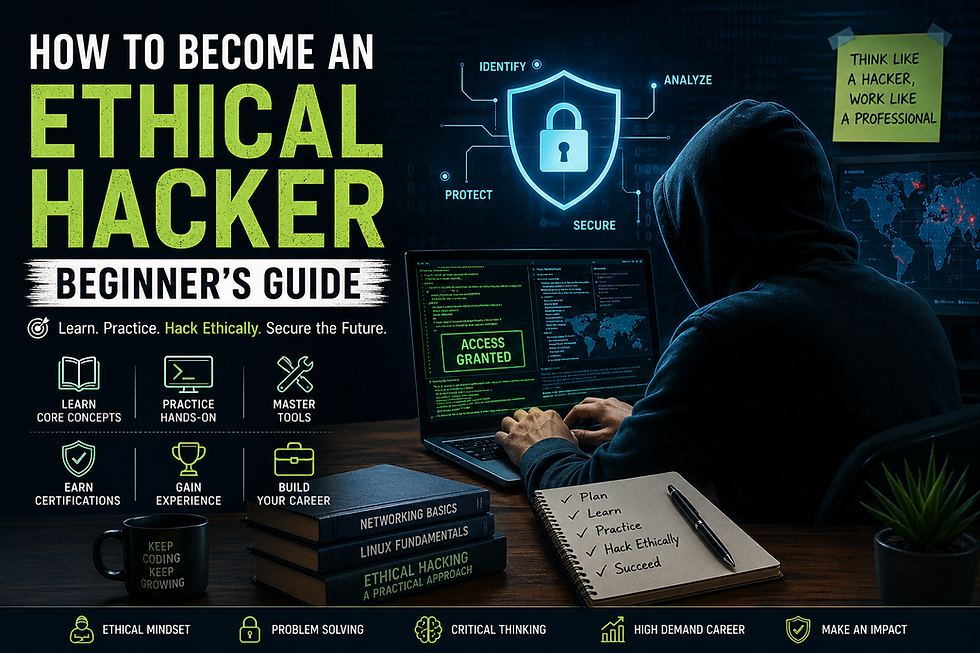
Ethical hacking is one of the fastest-growing career paths in the digital world. With the rise in cyber threats, organizations are actively looking for professionals who can identify vulnerabilities before malicious hackers exploit them. Ethical hackers, also known as white-hat hackers, play a crucial role in strengthening cybersecurity systems.
In this beginner’s guide, you’ll learn everything you need to start your journey—from basic concepts to essential skills and tools. Whether you're a student, IT professional, or someone curious about cybersecurity, this guide will help you understand how to become an ethical hacker step by step.
What is Ethical Hacking?
Ethical hacking refers to the process of testing computer systems, networks, or applications to identify security vulnerabilities—legally and with permission. Unlike malicious hackers, ethical hackers work to protect data and systems rather than exploit them.
They use the same techniques as cybercriminals but in a controlled and authorized environment. Their goal is to find weaknesses before attackers do. Ethical hacking is an important part of cybersecurity and helps organizations prevent data breaches, financial losses, and reputational damage.
Types of Hackers: White Hat vs Black Hat vs Grey Hat
Understanding the different types of hackers is essential for beginners. Hackers are generally classified into three categories:
White Hat Hackers (Ethical Hackers): These professionals work legally to improve system security. They are often hired by companies to perform penetration testing.
Black Hat Hackers: These are malicious hackers who exploit vulnerabilities for personal gain, often causing harm to individuals or organizations.
Grey Hat Hackers: They operate in between—sometimes breaking into systems without permission but without malicious intent.
Knowing these distinctions helps you understand the ethical responsibilities and legal boundaries of hacking.
Why Choose a Career in Ethical Hacking?
A career in ethical hacking offers numerous opportunities and benefits. With increasing cyber threats, demand for cybersecurity professionals is at an all-time high. Ethical hackers are needed in industries like banking, healthcare, IT, and government.
Apart from job security, this career offers high salaries, continuous learning, and global opportunities. It is also intellectually challenging and exciting, as you constantly solve real-world security problems. For those passionate about technology and problem-solving, ethical hacking is a highly rewarding career path.
Also Read: Ethical Hacking Course Eligibility
Key Skills Required to Become an Ethical Hacker
To succeed as an ethical hacker, you need a combination of technical and analytical skills. Some of the most important skills include:
Problem-solving and critical thinking
Strong knowledge of computer systems and networks
Understanding of cybersecurity principles
Attention to detail
Programming and scripting skills
Ethical hackers must also stay updated with the latest threats and technologies. Soft skills like communication and ethical responsibility are equally important, as professionals often need to explain vulnerabilities and solutions to non-technical stakeholders.
Educational Qualifications & Background
While there is no strict educational requirement to become an ethical hacker, having a background in computer science, IT, or cybersecurity can be highly beneficial. Many professionals hold degrees such as B.Tech, BCA, or related fields.
However, self-learning is also a viable path. With online courses, certifications, and practical experience, you can build strong skills without a formal degree. The key is to focus on hands-on learning and understanding real-world cybersecurity challenges.
Programming Languages Every Ethical Hacker Should Learn
Programming knowledge is essential for ethical hackers, as it helps them understand how systems work and how vulnerabilities can be exploited. Some important languages include:
Python: Widely used for scripting and automation
C/C++: Helps understand memory management and system-level vulnerabilities
JavaScript: Useful for web application security testing
SQL: Important for database-related attacks like SQL injection
Bash/Shell scripting: Helps automate tasks in Linux environments
Learning these languages will give you a strong foundation and make you more effective in identifying and fixing security issues.
Understanding Networking Fundamentals
Networking is the backbone of ethical hacking. Without understanding how networks function, it’s impossible to identify vulnerabilities. Key concepts include:
IP addresses and subnetting
TCP/IP protocols
DNS, HTTP, and FTP
Firewalls and routers
Ethical hackers analyze network traffic, detect anomalies, and find weak points in communication systems. A strong grasp of networking fundamentals allows you to perform penetration testing and secure systems effectively.
Basics of Operating Systems (Linux & Windows)
Ethical hackers must be comfortable working with different operating systems, especially Linux and Windows. Linux is widely used in cybersecurity because of its flexibility and powerful command-line tools.
Distributions like Kali Linux come pre-installed with hacking tools used for penetration testing. On the other hand, Windows knowledge is essential because many enterprise systems run on it.
Understanding file systems, permissions, processes, and system architecture will help you identify vulnerabilities and exploit them ethically.
Essential Cybersecurity Concepts for Beginners
Before diving deeper into ethical hacking, you must understand core cybersecurity concepts. These include:
Confidentiality, Integrity, and Availability (CIA Triad)
Encryption and cryptography
Authentication and authorization
Vulnerability assessment and penetration testing
Malware, phishing, and social engineering attacks
These concepts form the foundation of ethical hacking. By mastering them, you’ll be able to understand how attacks happen and how to defend against them effectively.
Popular Tools Used in Ethical Hacking
Ethical hackers rely on a variety of tools to identify vulnerabilities and secure systems. Some of the most widely used tools include Nmap for network scanning, Wireshark for packet analysis, Metasploit for penetration testing, and Burp Suite for web security testing. Tools like John the Ripper and Hashcat are used for password cracking.
Learning these tools is essential because they simulate real-world attack scenarios. Beginners should start with basic tools and gradually move toward advanced frameworks as their knowledge grows. Hands-on practice with these tools will significantly enhance your practical skills.
Step-by-Step Roadmap to Become an Ethical Hacker
Becoming an ethical hacker requires a structured approach. Start by learning the fundamentals of computer networks, operating systems, and programming languages. Next, build your knowledge of cybersecurity concepts and threats.
After that, move on to practicing with ethical hacking tools and performing basic penetration testing in controlled environments. Enroll in online courses or certifications to validate your skills. Finally, gain real-world experience through internships, bug bounty programs, or freelance projects. Consistency and continuous learning are key to success.
Certifications for Ethical Hackers (CEH, OSCP, etc.)
Certifications play a crucial role in establishing your credibility as an ethical hacker. Some of the most recognized certifications include:
Certified Ethical Hacker (CEH)
Offensive Security Certified Professional (OSCP)
CompTIA Security+
Certified Information Systems Security Professional (CISSP)
These certifications validate your skills and improve your job prospects. While certifications are not mandatory, they significantly boost your resume and help you stand out in the competitive cybersecurity job market.
How to Practice Ethical Hacking Legally
Practicing ethical hacking without permission can lead to serious legal consequences. Always ensure you have proper authorization before testing any system. Beginners should use legal platforms like virtual labs, capture-the-flag (CTF) challenges, and bug bounty programs.
Websites such as Hack The Box, TryHackMe, and OverTheWire provide safe environments to practice hacking skills. Following ethical guidelines not only protects you legally but also builds your reputation as a responsible cybersecurity professional.
Building Hands-On Experience (Labs, Projects, CTFs)
Practical experience is just as important as theoretical knowledge in ethical hacking. Setting up your own lab environment using virtual machines allows you to simulate attacks and defenses safely. You can create vulnerable systems and practice exploiting them.
Participating in CTF competitions helps improve problem-solving skills and exposes you to real-world scenarios. Additionally, working on personal projects, contributing to open-source security tools, or participating in bug bounty programs can significantly strengthen your portfolio.
Common Ethical Hacking Techniques & Methods
Ethical hackers use various techniques to identify vulnerabilities in systems. Some common methods include:
Footprinting and reconnaissance (gathering information)
Scanning networks for vulnerabilities
Gaining access through exploits
Maintaining access and analyzing security gaps
Other techniques include social engineering, phishing simulations, and password cracking. Understanding these methods helps ethical hackers think like attackers and proactively secure systems against potential threats.
Career Opportunities in Ethical Hacking
Ethical hacking opens the door to a wide range of career opportunities. Some popular job roles include:
Ethical Hacker / Penetration Tester
Cybersecurity Analyst
Security Consultant
Network Security Engineer
Information Security Manager
These roles are available across industries such as IT, finance, healthcare, and government sectors. As cyber threats continue to grow, the demand for skilled ethical hackers is expected to increase significantly in the coming years.
Salary & Job Outlook in Cybersecurity
The salary of an ethical hacker varies depending on experience, skills, and location. Entry-level professionals can earn a decent starting salary, while experienced ethical hackers can command high pay packages.
In countries like India, ethical hackers can earn anywhere from ₹4 LPA to ₹20+ LPA, depending on expertise. Globally, cybersecurity professionals are among the highest-paid in the IT industry. The job outlook is extremely positive, with millions of unfilled cybersecurity positions worldwide.
Tips to Stay Updated in the Cybersecurity Industry
Cybersecurity is a rapidly evolving field, and staying updated is essential. Follow industry blogs, watch webinars, and subscribe to cybersecurity news platforms. Join online communities and forums to learn from experts.
You should also practice regularly, experiment with new tools, and keep learning about emerging threats. Platforms like GitHub, Reddit, and LinkedIn can help you stay connected with the cybersecurity community. Continuous learning ensures you remain competitive in this dynamic field.
Also Read: How to Become an Ethical Hacker
Conclusion:
Becoming an ethical hacker is an exciting and rewarding journey that requires dedication, curiosity, and continuous learning. From understanding basic concepts to mastering advanced tools and techniques, every step contributes to building a successful career in cybersecurity.
With the right skills, certifications, and practical experience, you can become a highly sought-after ethical hacker. Start small, stay consistent, and keep upgrading your knowledge to succeed in this fast-growing industry.
Frequently Asked Questions:
Q1. Can a beginner become an ethical hacker?
Yes, anyone with interest and dedication can start learning ethical hacking from scratch using online resources and practice platforms.
Q2. Do I need a degree to become an ethical hacker?
No, a degree is not mandatory. Skills, certifications, and practical experience matter more in this field.
Q3. How long does it take to become an ethical hacker?
It can take anywhere from 6 months to 2 years depending on your learning pace and dedication.
Q4. Is ethical hacking legal?
Yes, ethical hacking is legal when done with proper permission and within authorized environments.
Q5. Which programming language is best for ethical hacking?
Python is highly recommended for beginners due to its simplicity and versatility.


Comments